Hario Skerton vs Mini Mill: Review


We get asked lots of questions about the differences between the Hario Skerton and the Hario Mini Mill Slim. "Which one is better?" "What are the differences between the two?" "Which one is preferable for the home/office/travel?" Even here at Prima some of us prefer grinding with the Skerton, while others prefer the Mini Mill for manual grinding. Hopefully we can provide some answers to questions being asked.
Size Comparison
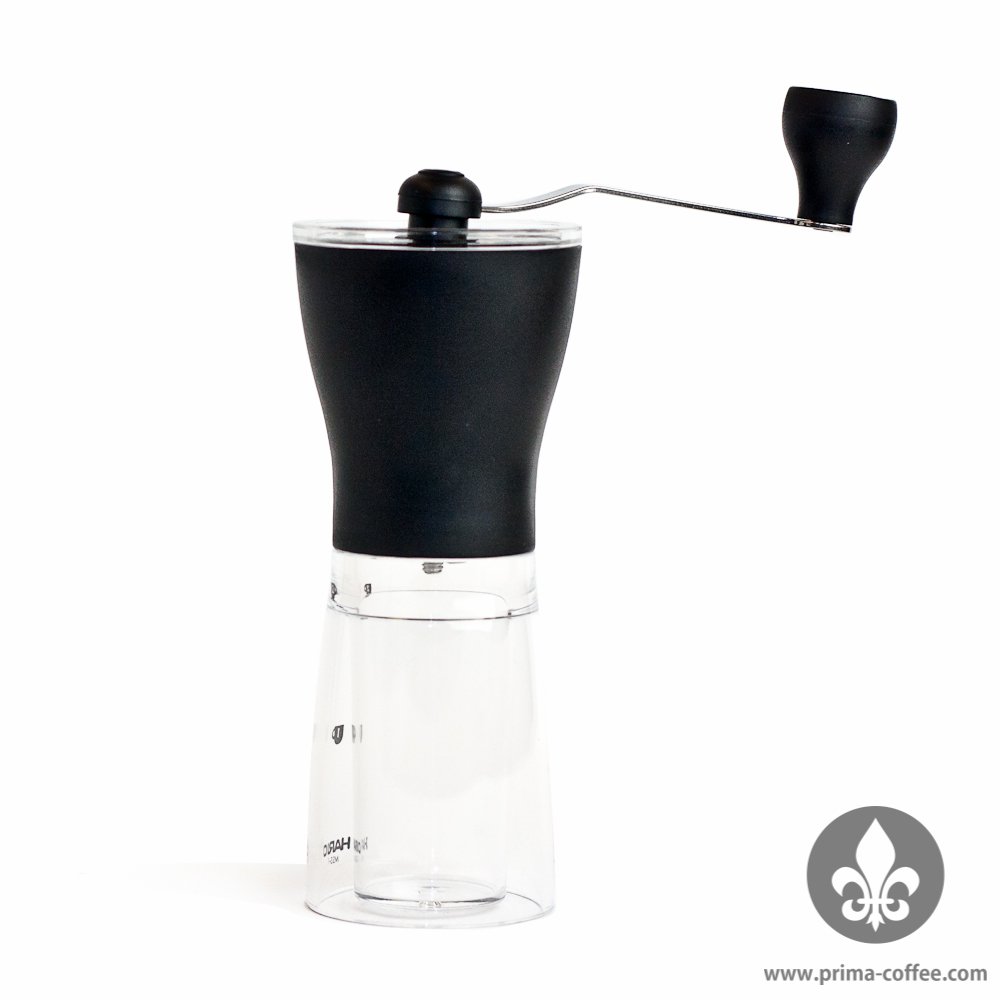
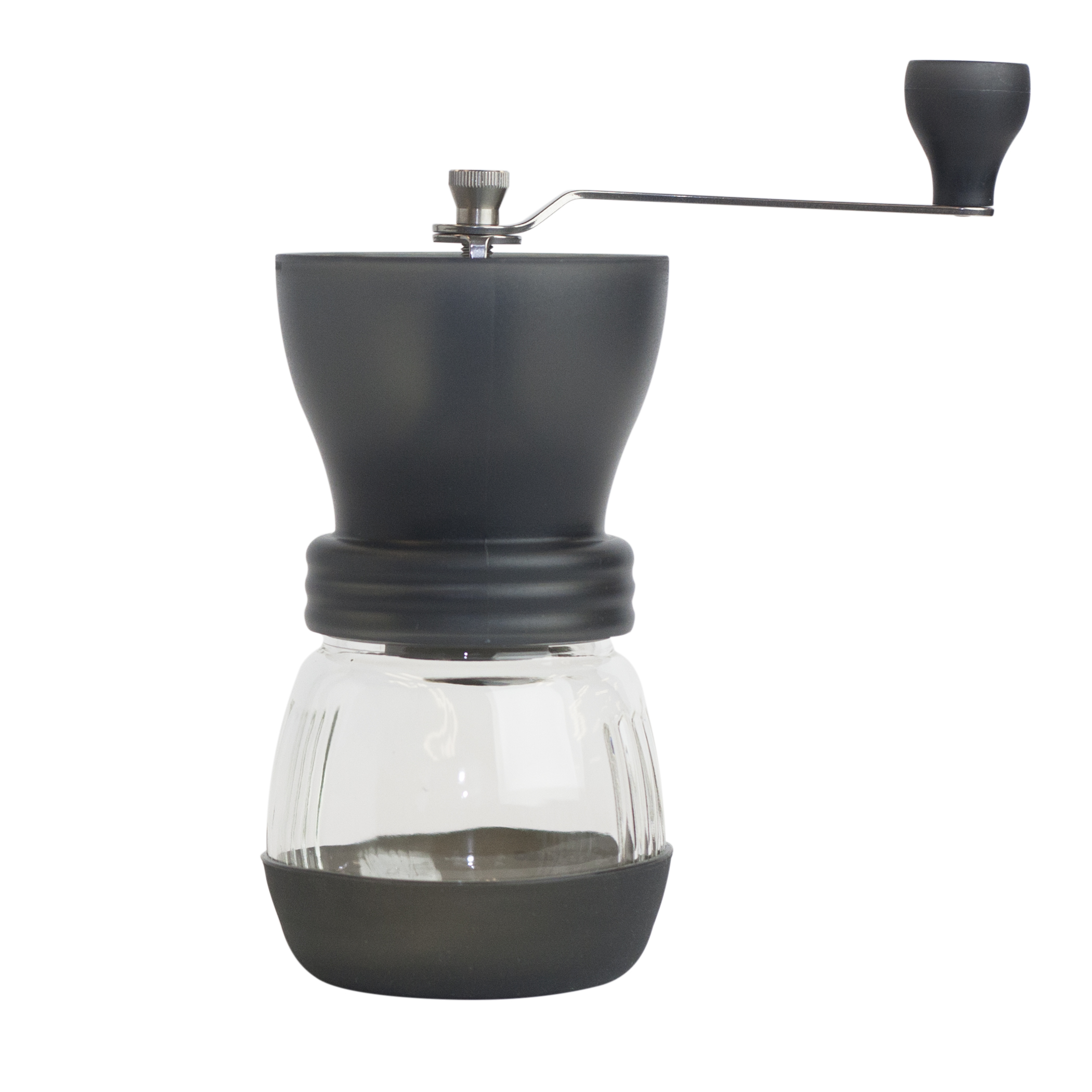
Both grinders are the same height, at approximately 18cm or just over 6in. The Skerton is much wider than the Mini Mill. Both carry hourglass figures, but at the middle of the grinder where the hopper attaches to the container, the Skerton is just over 7cm (or about 3in) while the Mini Mill is just under 5cm (or about 2in) wide at the middle. Capacity is the biggest difference between the two. The Skerton will hold about 60g of beans comfortably, but you can stretch it to 75g if needed, and the jar for the fines can hold the full amount placed in the hopper. The hopper on the Mini Mill will hold approximately 50g, but the container can only hold about 30g or so of fines, so you would need to dump them first if you were doing more than 30g.
Functionality
The two grinders are similar but different in functionality. With the Skerton, to adjust the grind you unscrew the top bolt, detach the handle, and adjust the steps to the desired grind. The Mini Mill on the other hand is adjusted from underneath the hopper, so you actually detach the hopper from the container to adjust the step grind. The Mini Mill seems to be more efficient with changing the grind setting in comparison with the Skerton, which takes a few more steps and a bit more effort. The Mini Mill has a lid which is very helpful in stopping those flying beans during grinding, while the Skerton has a larger container to hold more coffee and a rubber grip for stability while grinding. Grinding is simple; by no means effortless but comfortable enough that most anyone could handle it with ease. To grind around 30 - 60 grams can take anywhere from 2-4 minutes, depending on your speed. For a helpful tip on grinding, try placing either grinder between your legs while sitting to provide stability and a controlled rhythm while grinding.
Best Uses
The Mini Mill is a better choice for the home barista who...
The Mini Mill is a better choice for the home barista who normally only brews one to three cups of coffee at a time, or enjoys a shot or two of espresso in a sitting. The Mini Mill is a slightly slimmer option for travel, and there are no glass parts to be concerned with breaking in transit. For those who enjoy a french press for their preferred brew method, the Mini Mill edges the Skerton slightly because the burr is spring loaded helping keep a stable, consistent grind at a coarse setting.
The Skerton is preferable for the home barista who...
The Skerton is preferable for the home barista who enjoys brewing larger amounts of coffee. For syphon brewing, medium to large batch pour over brewing (30g-72g of coffee) or for several shots of espresso, the Skerton is the better choice. As for travel, while the glass container is more susceptible to breaking, it should be noted that the hopper on a Skerton will fit any Mason jar (learned that by experience!) which can be found at most any grocery store.
Summary
Both the Skerton and Mini Mill are excellent hand grinders which we recommend highly. Both are nice options for the coffee lover on a budget who wants a high quality burr grinder that can grind with the precision of electric grinders costing ten times the price. Both are awesome for travel and are fully machine washable. They are fun to have in your collection if you appreciate the artisan craft of hand brewing coffee and enjoy being fully involved in every aspect of the brewing process. Hopefully this article will help to give clarity on the strengths and weaknesses of each grinder so that you can make the best choice for brewing at home, the office or on the road!
- Lee
Thoughts From the Coffee Crew on the Skerton and Mini Mill
I've used the Skerton a good deal more than the Mini Mill, but the Mini Mill has been making up for lost time as of late. I really do love both of these little grinders. The Skerton feels sturdier in the hands and the rubber on the bottom glass chamber helps stabilize the grinder when grinding. As many have noted before with this grinder, grinding between the legs sitting down is the easy way to go. For me, the biggest plus for the Skerton is the feel and the ability to grind up to 70 grams.
The Mini Mill is quickly becoming one of my favorite coffee toys. There are three primary reasons that I currently prefer this little guy over its bigger brother. First of all, the way you adjust the grind setting is much easier on the Mini Mill than the Skerton as well as more easily reproducible. The dial you turn to adjust the setting on the Mini Mill actually clicks so you can tighten it all the way down and then count the clicks to have reproducible grind settings. The only question that I've yet to test is whether there are smaller increment adjustments on one grinder or the other. Secondly, the center rod of the Mini Mill has more support as well as a small spring that aids in stabilizing the movable burr. This helps keep the movable burr stable as you grind providing what should be a more consistent grind. With the finer settings this shouldn't be a huge deal but with more coarser grinds (as Lee noted above) the grind consistency should be better on the Mini Mill. Finally, I have a lot easier time grinding on the Mini Mill. This is probably partially due to the less beans going through the burrs ant any given time and partially due to the stabilizing spring and support just mentioned.
Both of these grinders produce excellent results that you won't find in any home grinder under a hundred bucks and can compete with many grinders over that price point. If you're constantly brewing for more than two people then the Skerton is the way to go. If you're brewing for yourself and one other I would recommend the Mini Mill.
- Matt
Editors note: Make sure to check out the Brewing Bundles we offer... of which many utilize the Skerton or Mini Mill at discounted prices.
Like this post? Then Subscribe to the Prima Coffee blog by email and get slick articles delivered right to your inbox. No web surfing required.
- 4/29 - Boston Translation or:...
- 4/9 - SCAA 2013: Boston-bound...
- 3/27 - Save Big with Bobby...
- 3/13 - 5 Smashing Coffee Beers...
- 2/15 - Latte Heart Winner...
-
The Baratza Vario looks much like Baratza's other offerings (i.e., the Encore, Virtuoso, and Preciso) in regard to silhouette, footprint, and general design. Those who've used them extensively, however, know that there's far more than mere nomenclature that separates the Vario from its brethren. Practically speaking, it has shown to give a consistently uniform and desirable grind for the full grind spectrum, all the way from espresso to press pot, something no other non-commercial grinder currently out on the market can boast. It is a highly efficient machine, wasting very little in the way of coffee grounds, but it shines in its ability to produce excellent espresso, shot after shot after shot, a feature aided by the three timed dosing presets it allows the user to store and recall at the push of a button.
-
Hario's stainless steel water kettle, the V60 Buono, has been spotted popping up in coffee houses and the kitchens of baristas for some time now. A detailed search on the web will reveal, for the moment at least, that the Buono seems to be widely accepted as the most useful pouring kettle available. What makes this kettle so popular amongst pour-over enthusiasts? Several reasons stand out.
First, the thin pouring spout enables greater pouring precision as well as a slower, more consistent and controlled rate of pour, both of which are very helpful in achieving a precise, prolonged extraction.
Second, the stainless steel construction and large 1 liter capacity contribute toward keeping up the brew temperature for the duration of the entire brew cycle.
Third, the ergonomics involved in the design of the kettle help to make using it much easier. This may not seem like much, but if you're brewing large batches of coffee and pouring for three or more minutes per batch, doing several batches of coffee will quickly become a chore if your kettle doesn't cooperate with you.
Combine all of these facets with the fact that the Buono is manufactured by Hario, a very popular name in the coffee-brewing community, and the kettle's popularity is easily understood. For best results, combine the Buono with a V60 Dripper or Chemex to get a truly exceptional cup of coffee. -
The Fretta Iced Coffee Brewer is Hario's answer to brewing the perfect cup of iced coffee. Hario has combined their famous V60 brewer with a decanter and plastic diffuser to assure that the coffee is quickly cooled by hitting ice immediately after the brewing process. This quick heat transition is important in conserving the flavor of the coffee. The Fretta comes with 10 size 02 paper filters. We recommend that you purchase extra filters as well. To do this select filters as an add-on from the options on the right or go to our Hario 02 filter listing. Also recommend is a pouring kettle. We offer both the Hario Buono Kettle as well as the Kalita Wave Pot Kettle in the drop-down menu on the right.


Disqus - noscript
I would love to know what grind settings your using on the ceramic slim. I just picked one up and I am trying to find a good place to start i.e. how many clicks from closed for a v60 or aeropress.
Hey Alex. As you know, grind setting can be a pretty subjective thing, influenced by a pile of factors. Still, we'd start somewhere within these ranges:
V60. 5-8 clicks from closed.
Aeropress short-brew (60 to 90-second contact). 5 or less clicks from closed.
Aeropress long-brew (90-second or higher contact). 7-10 clicks from closed.
Tell us what you find out, and have fun!
Hey, i've been using my mini mill for about a year now, I use it daily. I'm just wondering what you think the life span of the parts are, especially the burrs. I'm starting to get some inconsistency with my grind size, any tips?
Hey Simon. Ceramic burrs, like those in the Mini Mill, should last a very long time. If any of the components on that grinder were to go out within a year, it shouldn't be the burrs. Are any other parts loose or janky?
How often do you clean the burrs? It would help to run some grinder cleaner or minute rice through the grinder every couple of months. Let us know what this does for you.
Read your article after I just ordered the mini mill. I read other reviews on Amazon and in consideration of my needs of 1 to 2 people I chose the mini mill. Your article made me even happier with my choice. Now I must wait for the mail to deliver. That is the bummer part.
So glad, it helped, Gary! We think you'll really enjoy using it. Well worth the wait for sure!
Hi, great review! I picked up a mini mill, and am wondering if you have recommendations for "clicks" from tightest position for french press?
Hey Kyrill. Settings vary from grinder to grinder, especially when you use different coffees, but the best range for a press will probably start around 12 clicks and get coarser from there.
Hi, I really need some help with adjusting the grind setting on my Skerton... I can't seem to dial it in for the Kalita. Any advice?
What setting do you recommend on the mini mill for moka pots / stovetop espresso makers?
Hey Bennett. Moka pots are used a number of different ways. If you're hoping for an intense pseudo-espresso, you'll want to grind quite fine — just about as fine as the Mini Mill will take you. For a "basic" cup of coffee, we prefer a medium-coarse grind. This will probably be around 10 clicks from closed, but you'll want to play with it a bit. Hope that helps!
Hey J. We typically use a medium to medium-coarse grind when brewing with the Kalita (finer for small doses, coarser for large). I'm guessing that this will be somewhere between 8 and 12 clicks from closed on the Skerton, but you'll have to play around a bit. If you're still having trouble, send a picture of your ground coffee to pc.community@prima-coffee.com and we'll try to help.