Chemex »
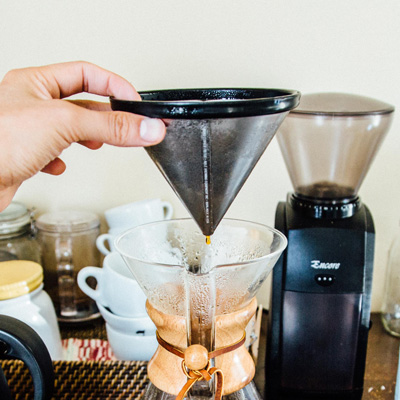
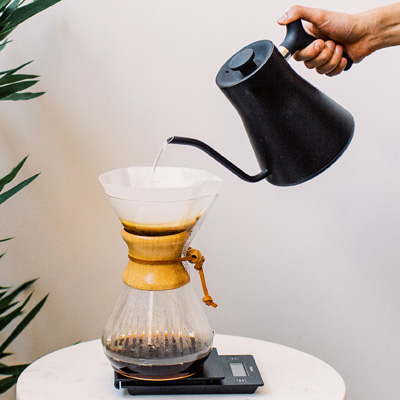
The Chemex® coffeemaker was invented by chemist Peter J. Schlumbohm, Ph.D., in 1941. Being a doctor of Chemistry, he was very familiar with laboratory apparati and the methods of filtration and extraction. He applied this knowledge when designing his coffeemaker by modifying the laboratory funnel, adding an "air channel" and a pouring spout. He added the "air channel" so the air displaced by the liquid dripping into the vessel could easily escape past the laboratory filter paper. Over the years, these items have been recognized as outstanding examples of American Design. In 1956, the Chemex coffee maker was selected by the Illinois Institute of Technology as one of the best-designed items of modern times, the only coffee brewer chosen for the award. The coffee maker and the water kettle are in the permanent collections of museums such as the Museum of Modern Art in New York, the Smithsonian, the Philadelphia Museum and the Corning Museum located in Corning, NY. When it comes to exceptionally tasting coffee made from a simple but elegant process, the Chemex has no rival.
Sort by
No results matched your search.
- 4/29 - Boston Translation or:...
- 4/9 - SCAA 2013: Boston-bound...
- 3/27 - Save Big with Bobby...
- 3/13 - 5 Smashing Coffee Beers...
- 2/15 - Latte Heart Winner...
-
It can be difficult in the world of specialty coffee to find a brewer that not only looks fantastic but also produces a fantastic product. Eva Solo has done an exceptional job of combining both elements into the Cafe Solo. The Solo seems a little strange upon first glance for the very reason that it may be the first coffee brewer of its kind: one that is clothed. The designers at Eva Solo had the ingenious idea of using the same material that keeps divers warm (neoprene) and wrapping it around the glass carafe... thus keeping the coffee hot during the 4 minute brewing period.
Not only are its looks something to take seriously, but the Solo's coffee is not to be underestimated. Because of its use of "total immersion" brewing (similar to that of a french press), the grounds are evenly and completely submersed in water. This provides extraction that is difficult to achieve by other methods of brewing. It is advisable, however, that once the 4 minutes of extraction is complete, the coffee should be immediately served or transferred into a thermal pot (we recommend one of the Zojirushi carafes). This will prevent over-extraction from taking place which results in a bitter tasting coffee.
The Cafe Solo is unquestionably a unique and exceptional specialty coffee manual brewer. Because of its simple usability and superior design, the Cafe Solo is a force to be reckoned with in the specialty coffee world. -
Hario's stainless steel water kettle, the V60 Buono, has been spotted popping up in coffee houses and the kitchens of baristas for some time now. A detailed search on the web will reveal, for the moment at least, that the Buono seems to be widely accepted as the most useful pouring kettle available. What makes this kettle so popular amongst pour-over enthusiasts? Several reasons stand out.
First, the thin pouring spout enables greater pouring precision as well as a slower, more consistent and controlled rate of pour, both of which are very helpful in achieving a precise, prolonged extraction.
Second, the stainless steel construction and large 1 liter capacity contribute toward keeping up the brew temperature for the duration of the entire brew cycle.
Third, the ergonomics involved in the design of the kettle help to make using it much easier. This may not seem like much, but if you're brewing large batches of coffee and pouring for three or more minutes per batch, doing several batches of coffee will quickly become a chore if your kettle doesn't cooperate with you.
Combine all of these facets with the fact that the Buono is manufactured by Hario, a very popular name in the coffee-brewing community, and the kettle's popularity is easily understood. For best results, combine the Buono with a V60 Dripper or Chemex to get a truly exceptional cup of coffee. -
Hario Skerton grinder is handy for manual home and travel grinding, it can also be slightly more cumbersome for an extended road trip where only a small amount of grinding will be done (for a more detailed comparison of the two grinders, check out this blog post: Hario Skerton vs. Mini Mill). For those trips (or homes) where a minimal amount of grinding is needed, the Hario Mini Mill Slim is the perfect grinding solution. The Mini Mill employs adjustable conical ceramic burrs for grinding any of the wide range of grinds employed in today’s coffee market. It can effortlessly handle 24 grams of anything from fine espresso to a coarse French Press setting. Because of its lightweight (0.5 lbs) and sleek plastic body, the Mini Mill easily fits into small carrying bags and suitcases without adding a lot of extra weight. This, in conjunction with the Aerobie AeroPress coffee maker, has the propensity to make excellent coffee anywhere hot water and fresh beans are available.
The Hario Mini Mill is a traveling coffee enthusiast’s dream come true.... and with its ability to grind to the fine quality needed for espresso, it can be paired with a hand-held travel espresso maker such as the mypressi TWIST (and an excellent choice of beans) to achieve a quality rivaling the product found in many high-end espresso machines. Whether the need is grinding beans for a french press, Aeropress, or mypressi, the Mini Mill Slim is the perfect travel solution.